
White noise
ProEndless Static Drift
Equal energy across every frequency, like a detuned radio or a strong fan. The classic choice for covering voices, traffic and sudden noises.
- Open-plan offices
- Noisy neighbours
- Short focus sprints
Noise colors
White, brown, pink, green, grey, blue and violet noise, plus warm and bright textures you won't find elsewhere.
Noise colors describe where a noise's energy sits. White noise has equal energy at every frequency and sounds like static; pink and brown noise put more energy in the low end and sound like rain or a deep rumble; blue and violet noise are bright and crisp. Solbox has 15 noise colors and textures, and brown noise is free.

Free on iPhone · iOS 17.6 or later
Start with the table, then try each one for a full work block.
| Noise | Character | Good for |
|---|---|---|
| White noise | Even, bright | Open-plan offices, Noisy neighbours, Short focus sprints |
| Brown noise | Deep, low | Long deep-work sessions, Falling asleep, Quieting a busy mind |
| Pink noise | Warm | Studying, Reading, Night-time listening |
| Green noise | Balanced | Gentle focus, Calm evenings, Background for reading |
| Grey noise | Balanced | Steady concentration, Masking office chatter, Sensitive ears |
| Blue noise | Bright, crisp | Waking up, Quick tasks, Cutting through low hum |
| Violet noise | Bright, crisp | Energetic work blocks, Short sprints, Creative sessions |
White noise
ProEqual energy across every frequency, like a detuned radio or a strong fan. The classic choice for covering voices, traffic and sudden noises.
Brown noise
FreeMost of the energy sits in the low end, so it sounds like a deep rumble, distant surf or a waterfall heard from inside. Softer on the ears than white noise, which is why many people with ADHD keep it on for hours.
Pink noise
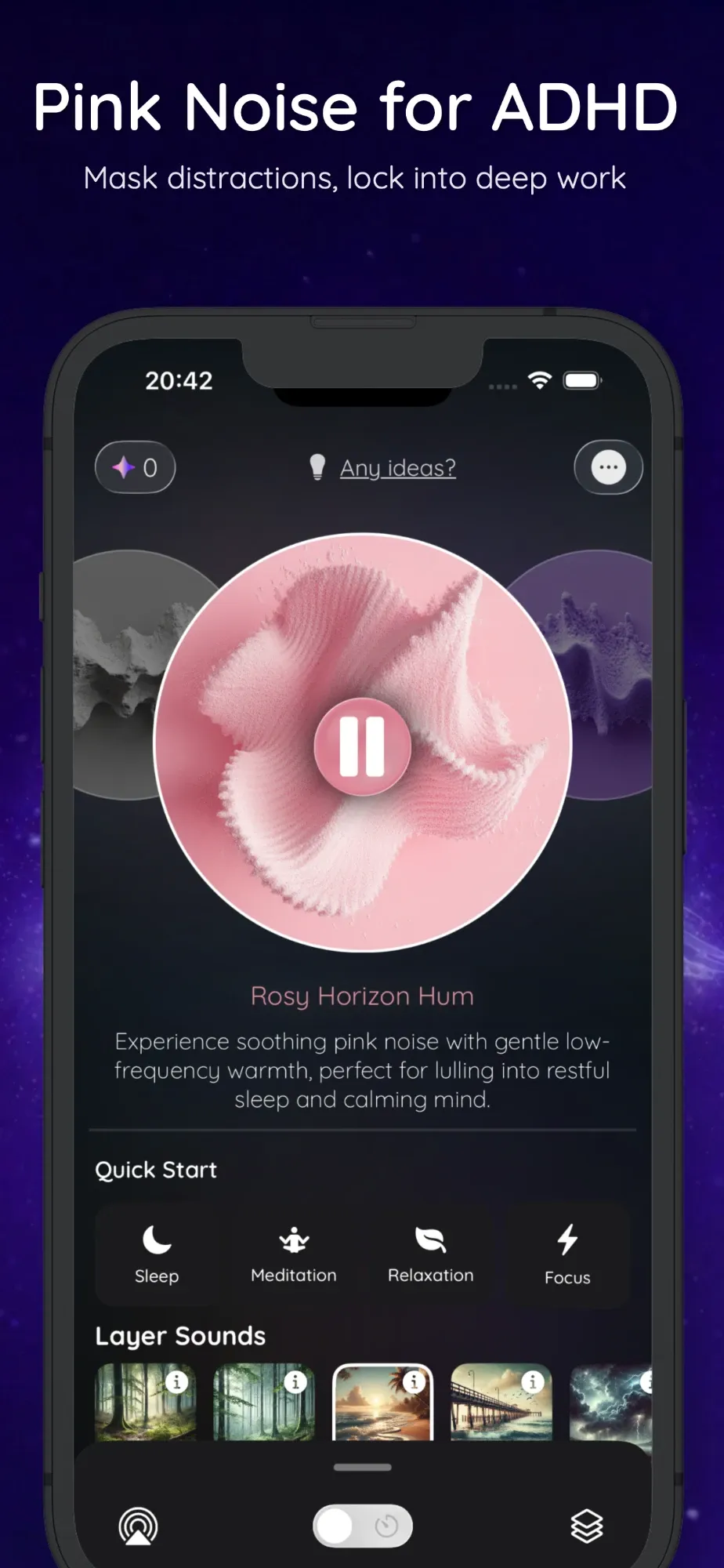
ProEnergy drops off evenly as the pitch rises, so it sounds like steady rain or wind in leaves. A gentle middle ground between white and brown.
Green noise
ProCentered on the middle frequencies, a little like the hum of a forest or a soft waterfall. Natural-sounding and easy to forget it's on.
Grey noise
ProShaped to sound equally loud at every pitch to the human ear. An even, neutral hiss that many people find less sharp than white noise.
Blue noise
FreeTilted toward the high frequencies, so it sounds crisp and bright, like a fine spray of water. Short, alert sessions suit it best.
Violet noise
ProEven brighter than blue noise, with most of its energy at the very top. A sharp, airy hiss for short bursts of work.
Mid-warm noise
ProA Solbox blend of low rumble and smooth midrange. Warmer than pink noise and lighter than brown.
Velvet noise
ProA smooth, warm midrange texture with no sharp edges. Sits quietly under music or speech.
Deep ground noise
ProAn even deeper low-end rumble than brown noise. Heavy, rooted and very easy to sleep to.
Bright focus texture
ProA crisp high-frequency texture that cuts through distractions without the harshness of plain white noise.
High shimmer texture
ProA shimmering high-frequency noise with a gentle pulse. Light and bright rather than heavy.
Rhythmic noise texture
ProA finely textured noise with a slow rhythmic swell and a little high-end shimmer, so it never feels static.
Flowing low-mid texture
ProA soft dual-tone wave in the low-mid range. Best with headphones.
Binaural focus tone
ProA 200 Hz base tone with a 7 Hz difference between the ears, designed to layer under any other sound. Needs headphones.
A noise “color” is a shorthand for its spectrum, the way its energy is spread from low to high frequencies. The names borrow from light: white light contains every color equally, and white noise contains every frequency equally.
There is no single winner. A 2024 meta-analysis of 13 studies found that white and pink noise gave a small benefit on task performance in children and young people with ADHD, though results varied from person to person and the studies were small. Brown noise has become hugely popular in ADHD communities even though it has barely been studied.
The practical answer: try each color for one full Pomodoro block. The right one is the one you stop noticing.
At night most people reach for deeper noise, such as pink, brown or Earth Hum, mixed with soft rain or distant thunder. Set a sleep timer so the sound fades out instead of stopping suddenly. For a side-by-side comparison, read white vs pink vs brown noise.
Beyond the classic colors, Solbox has eight textures designed for long sessions, like Amber Drift (between pink and brown), Velvet Noise (smooth midrange), Silver Static (a crisp focus texture) and Quartz Pulse, which has a slow rhythmic swell for people who find flat noise boring. Theta Sync is a binaural tone meant to layer under other sounds.
Pick a noise from the carousel on the Home screen and tap play. Each noise loops seamlessly, has its own volume, and can be layered with soundscapes or a binaural preset. Brown and blue noise are free; the rest come with Solbox Pro.
White noise has equal energy at all frequencies, so it sounds bright and hissy. Pink noise loses energy as the pitch rises and sounds like steady rain. Brown noise drops off even faster and sounds like a deep rumble or distant surf.
Many people with ADHD describe brown noise as calming and say it quiets their inner chatter. Research on brown noise specifically is still very limited, so the honest advice is to try it and see whether it works for you.
Green noise concentrates its energy in the middle frequencies, around where nature sounds sit. It sounds softer and more natural than white noise, a little like a forest or a distant waterfall.
Keep the volume low, around the level of a quiet conversation, and take breaks. Background noise should be easy to forget, and loud sound over long periods can harm your hearing.