
396 Hz
Free396 Hz — Release
Often used at the end of a hard day, to let the mind unwind before rest.
Solfeggio frequencies
Seven pure tones, each with its own soundscape and vibration pattern. Described honestly.
Solfeggio frequencies are a set of tones, such as 396, 528 and 852 Hz, that became popular in meditation and relaxation music. Solbox plays seven of them as pure tones layered over matching soundscapes. They are listening options; there is no solid scientific evidence for the health claims often made about them, and Solbox makes none.

Free on iPhone · iOS 17.6 or later
Labels use the Hz number and a mood word, the way they appear in the app.
396 Hz
FreeOften used at the end of a hard day, to let the mind unwind before rest.
417 Hz
FreeA popular pick for a fresh start in the morning or between two very different tasks.
432 Hz
ProA soft, rounded tone. Some musicians tune to 432 Hz because they find it warmer than the standard 440 Hz.
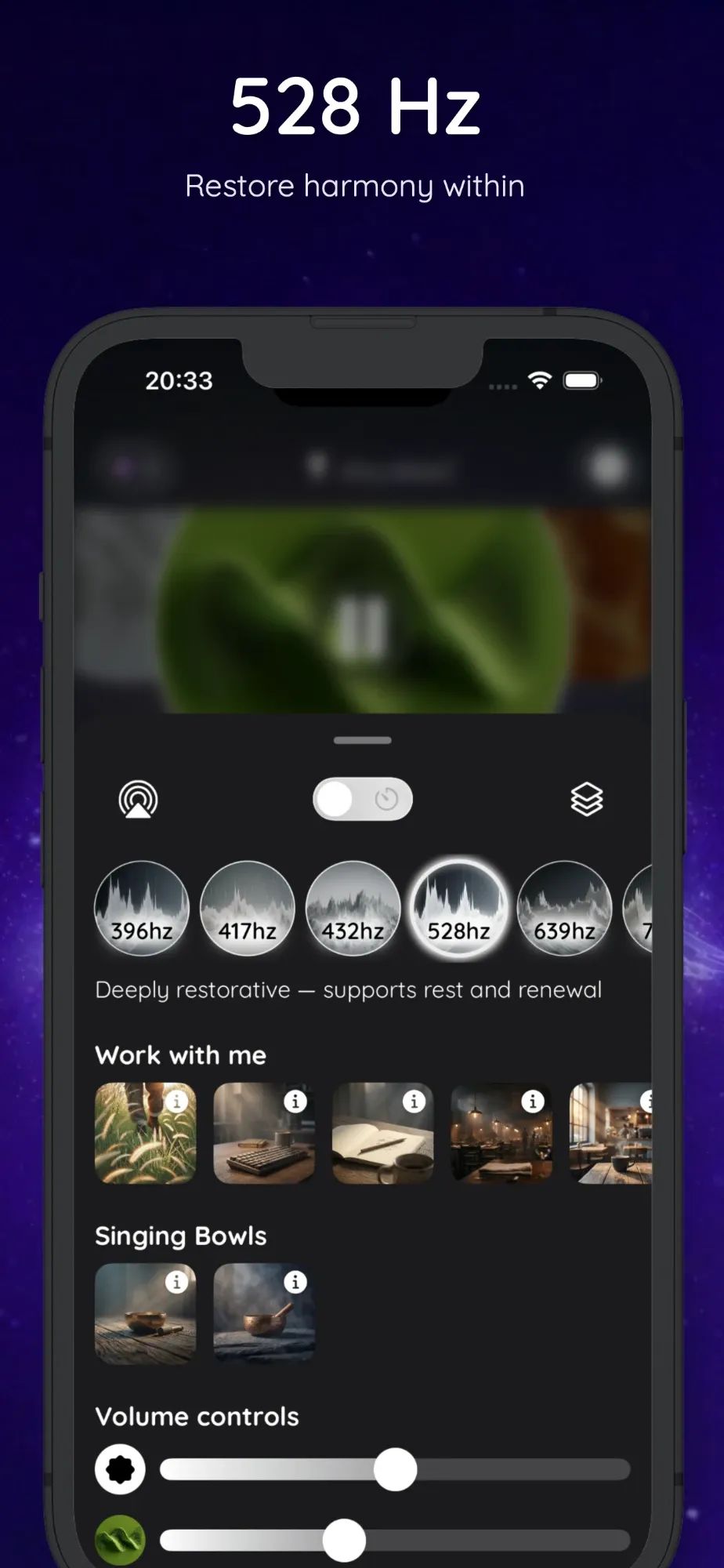
528 Hz
ProThe best-known solfeggio tone. Many people play it quietly under a soundscape for slow, restful evenings.
639 Hz
ProA warm mid tone people use for calm conversations, journaling or time with family.
741 Hz
ProA brighter tone that many listeners pair with focus work and a light noise underneath.
852 Hz
ProThe highest tone in the set, used for stillness, breathing exercises and quiet attention.
The word solfeggio refers to the sol-fa singing syllables (ut, re, mi, fa, sol, la). The modern list of “solfeggio frequencies” is much newer: it was first promoted in the 1970s, popularized by books in the late 1990s, and spread through relaxation and meditation music online, where each tone was paired with a meaning.
There is no historical record of these exact frequencies in early music, and no reliable research showing they have specific effects on the body. People still enjoy them, the same way they enjoy a singing bowl or a particular chord.
All seven are pure sine tones, the simplest possible sound. Lower tones like 396 and 417 Hz feel round and soft; 741 and 852 Hz are brighter and more noticeable. In Solbox each tone plays quietly over its own soundscape, so it blends into the background instead of ringing in your ears.
Solbox labels each tone with the Hz number and a mood word, like 528 Hz — Renewal, so you can pick by feel rather than by claim.
Open the pull-up panel and swipe the frequency carousel. Tap a tone to play it with its soundscape, then adjust the tone and soundscape volumes separately. With haptic sync on, each tone also has its own gentle vibration pattern. 396 and 417 Hz are free; the other five come with Solbox Pro.
They are a set of specific tones, most often 396, 417, 528, 639, 741 and 852 Hz, first promoted in the 1970s and widely popularized from the late 1990s in meditation and relaxation music. Many lists also include 432 Hz, a tuning some musicians prefer.
528 Hz is the most popular solfeggio tone, and many people play it quietly under a soundscape for calm, restful evenings. Strong claims made about it online are not supported by good evidence.
Strictly speaking, no. 432 Hz is an alternative tuning for the note A, popular with musicians who find it warmer than the standard 440 Hz. It is often listed alongside solfeggio tones, so Solbox includes it.
Yes. Each tone in Solbox comes with its own soundscape, and you can add any noise color or ambient layer underneath and set each volume separately.